India Stoker
(Mia Wasikowska) has recently lost her father Richard (Dermot Mulroney) to a
car accident. During the wake, a mysterious man unknown to India appears at her
house. He is introduced by her mother Evelyn (Nicole Kidman) as Uncle Charlie
(Matthew Goode), Richard’s brother who has been travelling the world hence his
absence. Charlie decides to integrate himself in the Stoker house, so he can
support Evie and India through their mourning period. India and Evie find
themselves drawn to Charlie, but he has his own desires and secrets that
threaten the Stoker household.
Showing posts with label Park Chan-wook. Show all posts
Showing posts with label Park Chan-wook. Show all posts
Wednesday, 25 February 2015
Tuesday, 24 February 2015
I’m a Cyborg, But That’s OK (2006): ***
Young-goon (Im Soo-jung) believes she is a cyborg; she
refuses to eat food and licks batteries instead to charge up. After she tries
to charge up by attaching wires into her slit wrist and plugging herself into
an outlet, Young-goon’s mother (Lee Yong-nyeo) has her committed at a mental
hospital. At the institute, Young-goon happily chats to the fluorescent lights
and the coffee machine during the day, before dutifully listening to the voice
from her radio, who orders her to kill the hospital staff. Young-goon attracts
the attention of Il-soon (Rain), an anti-social kleptomaniac who believes he
can steal his fellow patients’ characteristics, who decides to try and support
her whilst she’s at the hospital.
Friday, 16 January 2015
Park Chan-wook's Vengeance Trilogy: The Politics Behind The Blood - Part 2
Sympathy for Mr. Vengeance (2002)
Sympathy
for Mr Vengeance (2002) - the first film in the Vengeance trilogy - follows
Ryu (Shin Ha-kyun), a deaf-dumb man caring for his sick sister (Im Ji-eun), who
is in desperate need for a new kidney. After Ryu is laid off from his job, he
tries to obtain a kidney from the organ black market, exchanging one of his own
kidneys and 10 million won for a kidney for his sister. However, Ryu is tricked
by the organ dealers and doesn’t get the kidney for his sister. Later, he finds
out that a kidney is available from the hospital but he cannot afford to pay
for the operation. His anarchist girlfriend Yeong-mi (Bae Doona) devises a plan
to kidnap the daughter of the executive who fired him, to raise the money needed
for the operation. However, after an incident between Ryu’s old boss and a
former worker Peng (Fujimoto Masashi), they decide to kidnap another
executive’s daughter Yu-sun (Han Bo-bae) to avoid raising suspicions. However,
their plan goes terribly wrong, with Ryu’s sister committing suicide and Yu-sun
accidently drowning. Yu-sun’s father Park Dong-jin (Song Kang-ho) seeks out his
revenge against his daughter’s kidnappers/killers and Ryu takes revenge against
the organ dealers. As with many revenge films, Sympathy for Mr Vengeance ends with the death of numerous
characters, including but not limited to, Yeong-mi, Ryu and Dong-jin.
Director Park
Chan-wook in an interview mentioned one of the themes present in Sympathy for Mr Vengeance, ‘But Sympathy
for Mr. Vengeance had very political aspects…I wanted to deal with the class
problem within South Korea’ (Smith, Bright
Lights Film Journal, 01.08.06). Many of South Korea’s values come from
Confucian ideals, particularly the idea of respect and reciprocity in all
relationships, between friends, siblings, parents, the ruler and subject and so
forth (Insook and Lee-Jay 1995). As such, ‘Confucianism is hierarchical and
mandates subordinates to respect the wishes of superiors, but it also dictates
that those in authority be responsible and look after their subordinates’ (Shultz 2002: 8). However, the
introduction of capitalist ideals in South Korea changed these values, at least
for the younger generation. Any form of individualism was seen as a bad
mind-set, it went against the centuries-old Confucian values, until the
economic boom in the 1980s where young people could succeed using capitalist
ideologies (Buzo 2002: 167). This change in ideals appears to be reflected in Sympathy for Mr Vengeance in the
character of Dong-jin. Executive Dong-jin appears to be unconcerned with the
fate of his fired workers at first; he does nothing when Peng is begging for
his job back to support his family. Dong-jin only becomes concerned when Yu-sun
dies and he realises that one of his ex-workers might be responsible. Then Dong-jin
visits Peng at his home, to discover that Peng has committed suicide and took
his family with him.
Sympathy for
Mr Vengeance can be read as a critique of capitalist ideals. Ryu
decides to use the free market approach when trying to find his sister a kidney.
He phones a group of black market organ dealers to make an exchange, Ryu is
told to bring a red rose so they know who to pick up to discuss he exchange. In
an abandoned building, the organ dealer and doctor states that Ryu will give
her the 10 million won and one of his kidneys, Ryu makes no attempt to bargain
and he is unable to, due to his inability to speak. Thus, it only appears to be
a free market, the organ dealer controls the negotiations and economics of the
deal, whilst Ryu the consumer can do nothing to influence it. When Ryu wakes up
after being anesthetized, he is missing a kidney, with the rose next to him and
has been left in the building. The rose could be seen as a metaphor for
capitalism, it seems promising at first appearance, but it belies the painful
thorns beneath the surface.

Later, Ryu is contacted by the doctor, happily
stating that a kidney has ‘miraculously’ become available for his sister. Ryu
has only to pay a set amount for the operation, which he now cannot afford as
he gave all of his money to the organ dealers. Ryu is punished for trusting the
free market to help his sister.

It is also notable that during Peng’s confrontation
with Dong-jin, there are several TGI Friday’s balloons which feature
prominently in several shots. Ryu’s weapon of choice is the baseball bat,
perhaps suggesting that American culture is in a small way responsible for the
undermining of tradition Korean values?
A large emphasis throughout the film is placed on the spatial distance
between Seoul and the outer regions, reinforcing the class differences between
Ryu, Peng and Dong-jin. Often the camera will zoom out from the action and pan
across to focus on Seoul far away in the distance. It occurs when Ryu and
Yeong-mi are playing in the nearby park with Yu-sun, who is oblivious to her
kidnapping, displaying the distance between Yu-sun’s home and Ryu’s home.
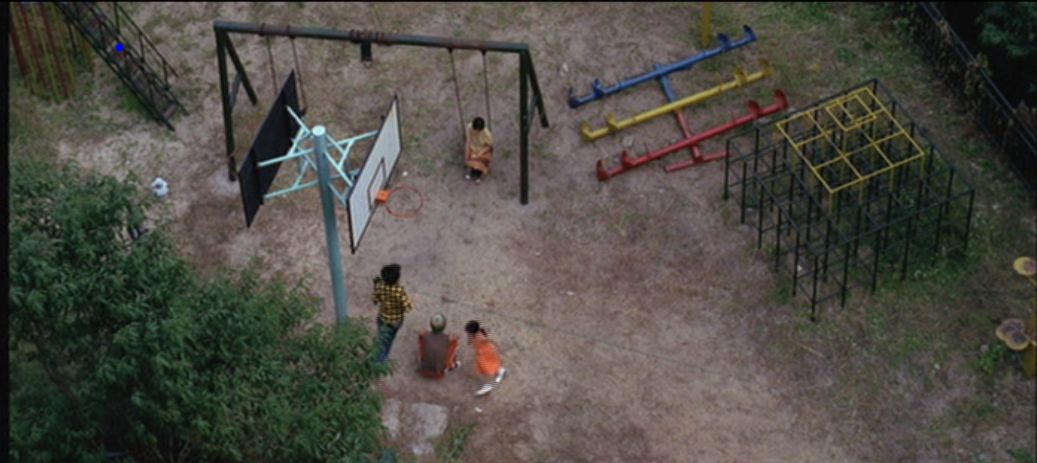

Also, the vast scale of poverty is emphasised, particularly when
Dong-jin visits Peng’s family home. Again the camera tilts upwards and zooms
out to show hundreds of slum homes in the outskirts of Seoul, showing hundreds
of families who are struggling to find work.

Dilapidated buildings, lonely
roads and deserted scrublands served to reinforce this idea of isolation, representing
the economic downfall South Korea experienced in 1997 or the loss of
collectivist ideals in favour of individualism.

Revenge films often contains a series of ironic symmetries and Sympathy for Mr Vengeance is no
different, particularly in the injuries and deaths of our main characters.
Yeong-mi was the mastermind behind the kidnapping of Yu-sun; she was the brains
of the operation. Yeong-mi is killed by Dong-jin by attaching electric cables
to her ear lobes and electrocuting her to death.

Ryu set the tragic course when
he approached the organ dealers and surgeon to obtain a kidney. Ryu is severely
injured by being stabbed in the stomach with a scalpel, reflecting why Ryu
approached the organ dealers in the first place. Ryu is later drowned in the
river, where Yu-sun died due to his negligence, by Dong-jin. Lastly Dong-jin
receives his first injury when he is trying to restrain Peng, his left palm is
sliced, a punishment for treating his workers poorly. At the end of the film,
Dong-jin is found by members of Yeong-mi’s group, who are out to avenge her. He
receives another cut on his right hand, which mirrors the one on his left hand,
retribution for showing no mercy towards Yeong-mi.

He is stabbed repeatedly
until finally, Dong-jin is stabbed in the chest, with a note from the group
attached to the embedded knife. He is left to die opposite the dismembered
remains of Ryu’s body, thus completing the cycle of revenge.

Sympathy
for Mr Vengeance utilises the revenge tragedy genre in order to also
explore class issues in South Korea, making a subtle criticism about the deterioration
of traditional Korean ideals. These issues are manifested in the spatial
relations within the film, how the characters react to one another and in the
consequences of their decision-making. This short analysis should hopefully
shine a bit of light onto the political subtext of Park Chan-wook’s films,
although Sympathy for Mr Vengeance is
perhaps one of his more overtly political films. Upcoming is an analysis of the
cult favourite and Park’s most infamous film Oldboy (2003).
(All photos: Studio Box/Tartan Films)
(Note: This is a continuation from a presentation on Revenge Tragedy and Oldboy, created by myself and Miss A. Izatt)
(Note: This is a continuation from a presentation on Revenge Tragedy and Oldboy, created by myself and Miss A. Izatt)
Bibliography
Buzo, A.
(2002) The Making of Modern Korea. London: Routledge
Insook, H.
P. and Lee-Jay, C. (1995) ‘Confucianism and the Korean Family’ Journal of
Comparative Family Studies, Vol. 26 (1), p. 117-134.
Schultz, E.
J. (2002) ‘Top Ten Things To Know About Korea In The 21st Century’ Education about Asia, Vol. 7 (4), p.
7-10. Available from: https://www.asian-studies.org/eaa/Korea-Ten-Things.pdf
[accessed 16/01/15]
Smith, D.
(2006) ‘Acts of Revenge: Director Park Chan-wook Discusses Lady Vengeance and More’ Bright
Lights Film Journal [online] Tuesday
1st August. Available from: http://brightlightsfilm.com/acts-revenge-director-park-chan-wook-discusses-lady-vengeance/#.VJXw8f8M0A [accessed 16/01/15]
Monday, 22 December 2014
Park Chan-wook's Vengeance Trilogy: The Politics Behind The Blood - Part 1
Context
South Korea's most prolific film-maker Park Chan-wook has earned a reputation in the West for making extremely violent films, most notably in his: 'Vengeance' trilogy consisting of: Sympathy for Mr. Vengeance (2002), Oldboy (2003) and Sympathy for Lady Vengeance (2005). Oldboy is the most well-known of Park's films: championed by Quentin Tarantino at the Cannes Film Festival in 2004 (Lawson, The Seattle Times, 17.04.05), winning that year's Grand Prix and achieving cult status amongst film lovers. Oldboy and Park Chan-wook himself have been marketed to Westerners as part of 'Asian extreme cinema'. Other directors who are placed in this category include Miike Takashi and Fukasaku Kinji: Miike for Audition (1999) and Ichi the Killer (2001), Fukasaku for Battle Royale (2000) (Choi and Wada-Marciano 2009: 5). As a consequence of this branding and the violent content of Park's Vengeance trilogy, one criticism aimed at these films was one of hollowness. Some critics felt that Park Chan-wook was more concerned with style than substance. New York Times' film critic Manohla Dargis believed Oldboy was:
Peter Bradshaw, whilst reviewing Sympathy for Lady Vengeance, stated that:....symptomatic of a bankrupt, reductive postmodernism: one that promotes a spurious aesthetic relativism....In this world, aesthetic and moral judgments - much less philosophical and political inquiries - are rejected in favor of a vague taxonomy of cool that principally involves ever more florid spectacles of violence (25.03.05).
....there is no serious intent in this "trilogy" to consider revenge in any but the most stylised way. The idea of revenge being messy or futile or counter-productive, as it tends to be in the real world, has not played a serious part. (The Guardian, 10.02.06)
I would like to challenge the opinion the Vengeance trilogy is an insubstantial series of films as critics like Dargis, and to a lesser degree Bradshaw, suggest, but argue rather they are highly political and certainly do not condone revenge. I will be looking at the Vengeance trilogy in depth, starting with Sympathy for Mr Vengeance, to analyse how they critique modern society in South Korea and how revenge is ultimately portrayed as a futile endeavour. However, in order to best understand these films, some historical and social context is required.
The last century of South Korea's history has been very turbulent. From 1910-45, Korea was under the colonial rule of Japan. Japan tried to make the Korean population assimilate Japanese culture, the most notable example was the mass change of names from Korean to Japanese. 450,000 Korean men were sent to Japan as forced labourers and an unknown amount of Korean women were taken as 'comfort women'. After the defeat of Japan at the end of WWII, the UN decided to split Korea into North Korea and South Korea in 1948. This lead to a civil war between North and South Korea which lasted from 1950 to 1953, ending after the Korean Armistice Agreement was signed, although no official peace agreement has ever been agreed to.
In 1960, a protest was held as a reaction to electoral corruption. The April Revolution, as it became know, had over 100,00 students in Seoul protesting. The police opened fire on the protest, killing over 140 students and injuring thousands. During this time of political instability, a military coup was held, overthrowing the government and placing military general Park Chung-hee as President. From 1961 to 1993, South Korea was under a military regime, which each President succeeded by a member of the military authority. During this time, there was heavy censorship and limited freedoms for the Korean population. One notorious event which occurred during this period of military rule was the Gwangju Massacre of 1980, where at least 165 protesters were killed by soldiers, under the orders of the current President at the time, Chun Doo-wan.
1993 brought the first election of a civilian President, Kim Young-san, in over 30 years. The democratic government also increased the gradual removal of censorship in cinema, which began in the late 1980s. However, the new democracy was struck by a financial crisis and were forced to turn to the IMF (International Monetary Fund) to bail them out. The IMF loaned them the necessary money but it came with strict conditions, causing many local businesses to collapse and the economy to shrink.
This is a very brief summary of recent events in South Korea's history, but it demonstrates the sheer amount of social disruption and violence the Korean population has been exposed to. Film critic Darcy Paquet has noted that the nature of these extreme and bloody events have, '...arguably carried over into many Korean films' (2009: 4). It is important to note that Park Chan-wook was born in 1963
and Park believes that his films are a reflection of his upbringing in South Korea. In an interview, Park stated:
"...I guess I probably make violent films partly because I can't express my anger in my real life very well. There are always times in your life where people have humiliated you and you haven't been able to stand up for yourself." Park attributes his slightly desensitised attitude [towards violence] to a youth influenced by his protesting, academic parents, and becoming a student protester himself...in the 1980s... (Hubert, The Guardian, 17.10.09)Although his films are violent in nature, it belies the deep political subtext of his films. It is hard to believe that Park, who was actively political and surrounded by political parents, could discard any form of politics in his films. Most Western critics might not be aware of South Korea's history and its cultural background, thus the more political elements of Park's films may go by completely undetected. These upcoming essays will analyse Park Chan-wook's films and the political commentary going on within them, in hope of shedding some light on the inner workings of his films.
(Note: This is a continuation from a presentation on Revenge Tragedy and Oldboy, created by myself and Miss A. Izatt)
Sources
The historical facts about South Korea were gleaned from Wikipedia
Bradhsaw, P. (2006) 'Lady Vengeance' The Guardian [online] Friday 10th February. Available from: http://www.theguardian.com/culture/2006/feb/10/8 [accessed 21st December 2014]
Choi, J. and Wada-Marciano, M. (2009) 'Introduction.' In: Choi, J. and Wada-Marciano, M. (eds.) Horror to the Extreme: Changing Boundaries in Asian Cinema. Hong Kong: Hong Kong University Press: 1-12
Dargis, M (2005) 'The Violence (and the Seafood) Is More Than Raw' The New York Times [online] Friday 25th March. Available from: http://www.nytimes.com/2005/03/25/movies/25boy.html?ex=1143262800&en [accessed 21st December 2014]
http://www.festival-cannes.com/en/archives/2004/awardCompetition.html
Hubert, A. (2009) 'Shock horror! Park Chan-wook is refreshingly normal' The Guardian [online] Saturday 17th October. Available from: http://www.theguardian.com/film/2009/oct/17/park-chan-wook-thirst [accessed 22nd December 2014]
Lawson, T. (2005) 'Tarantino opens doors for graphic Korean director' The Seattle Times [online]. Sunday 17th April. Available from: http://seattletimes.com/html/movies/2002242446_oldboy17.html [accessed 21st December 2014]
Paquet, D. (2009) New Korean Cinema: Breaking the Waves. New York: Wallflower.